
Warehouse Lighting For UK Businesses
Warehouse LED Lighting
With modern LED high-bay and low-bay systems, legacy fluorescents are fast disappearing from UK warehouses. Today’s facilities prioritise safety, efficiency and uptime, LED optics, smart sensors and precise lux levels improve visibility in aisles and loading bays while cutting energy use and maintenance.
Start Saving On Warehouse Energy Costs
LED warehouse lighting replaces outdated fluorescent and metal-halide fittings with high-bay/low-bay systems that deliver even lux levels across racking aisles, picking zones and loading bays. Expect up to 60–70% energy savings, 50,000+ hour L80 life, low-glare optics (UGR-friendly), and IP65/66 durability. Add PIR/microwave motion sensors and daylight harvesting to cut costs in empty aisles, and integrate emergency lighting to BS 5266 for compliance. Not sure how many high-bay lights you need or what lumen level is best for a warehouse? Book a free lighting survey, lux plan and ROI report, we’ll size fittings to your ceiling height and layout, specify 4000–5000K, CRI 80/90 options, and handle full installation with minimal downtime.
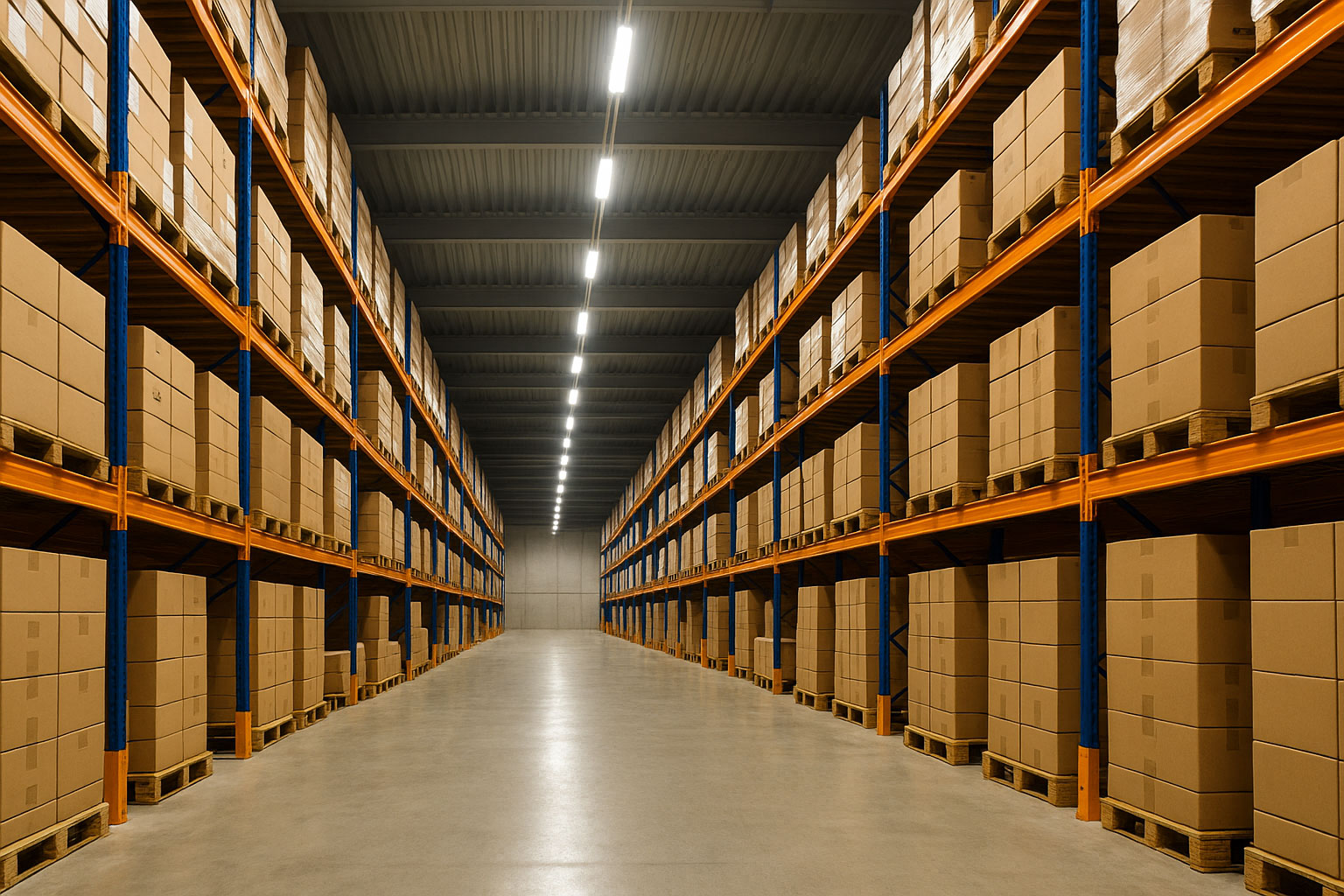
UK compliance, lux levels & smart controls

How Many High-bay Lights Do I Need?
A quick rule of thumb: start with your area × target lux ÷ lumens per fitting. For example, a 2,000 m² warehouse at 200 lux with 30,000 lm fittings needs ~13–14 fixtures per 1,000 m² (final count depends on optics and losses). Then refine by mounting height and spacing: at 8–10 m, space fittings at ~1.0–1.2× mounting height; at 12–14 m, 1.2–1.5× is typical. Aisle layouts benefit from narrow aisle optics to push vertical light onto racking labels. We’ll model this with a lux plan so you get even coverage without over-specifying.
High-bay Spacing & Mounting Height
Pick output and optics to suit ceiling height and task. At 8–10 m, 15–22k lm wide/aisle optics usually cover general storage; at 10–12 m, 22–30k lm with medium/aisle optics is common; at 12–14 m, 30-40k lm with tighter beams keeps lux on the floor and racks. Manage glare with UGR-aware optics and position fittings offset from forklift routes where possible. Add PIR/microwave sensors with time-outs and daylight harvesting for empty aisles, often the fastest route to big, measurable savings.
LED Warehouse Installation Benefits
OSHA requires warehouses with heavy equipment to have at least 2 lumens per square foot (foot-candles). Lumens are based on the wattage of light fixtures and the area size. LED high bay lights are perfect for warehouses with ceilings over 20 feet high. They’re designed to provide effective lighting at these heights. You’ll need the right brightness for your space—too much light could cause glare. A bright, crisp white light helps keep staff alert, ensures good visibility of stock and labels, and meets the recommended 150 LUX by the Chartered Institute of Building Services Engineers (CIBSE)
- Improved Visibility: LED lights provide bright, uniform lighting that ensures workers can clearly see shelves, stock, and labels, reducing errors and improving safety.
- Energy Efficiency: LEDs consume less power than traditional lighting, lowering energy bills while providing high-quality illumination.
- Longer Lifespan: LED lights last much longer than other types, meaning fewer replacements and less maintenance in busy warehouse environments.
- Reduced Glare: Properly installed LED lights reduce glare, which can cause eye strain and discomfort for workers, ensuring a more comfortable environment.
- Durability: LEDs are resistant to vibrations and shocks, making them perfect for warehouses where equipment, carts, and pallets are in constant motion.
- Consistent Light Output: Unlike other lights that can dim over time, LEDs maintain consistent brightness for longer, helping to maintain optimal working conditions.
- Better Worker Safety: Proper lighting, including sufficient brightness and minimal shadows, helps prevent accidents and injuries by providing clear sight-lines and reducing the risk of trips or falls.
- Lower Maintenance Costs: With their long lifespan and durability, LEDs require less maintenance, saving on labor and replacement costs.
- Customisable Lighting: LEDs can be easily dimmed or adjusted, allowing for flexible lighting solutions that match the specific needs of different warehouse tasks or times of day.
- Environmental Benefits: LEDs are eco-friendly, containing no toxic substances like mercury, and they help reduce the carbon footprint of the warehouse by using less energy.
Why choose LED Warehouse Lighting
Promoting Focus & Productivity
Improved Visibility
LED lights provide bright, uniform lighting that ensures workers can clearly see shelves, stock, and labels, reducing errors and improving safety.
Reduced Glare
Properly installed LED lights reduce glare, which can cause eye strain and discomfort for workers, ensuring a more comfortable environment.
Better Worker Safety
Proper lighting, including sufficient brightness and minimal shadows, helps prevent accidents and injuries by providing clear sight-lines and reducing the risk of trips or falls.
LED Warehouse Lighting; What to Choose & Why
Quick guide to the right luminaire for aisles, racking, packing and yards, built around safety, compliance and savings.