
Poultry & Livestock LED Lighting
Poultry & Livestock LED Lighting Services
LED lighting has become essential for modern poultry farms due to its energy efficiency and precise control. Unlike old-school incandescent and fluorescent bulbs, LEDs use less energy, produce less heat, and give farmers control over the light spectrum and cycle. This helps improve poultry behaviour, growth, and well-being.
Standards & Compliance (factory focus)
We design farm lighting to BS EN 12464-1 (and relevant welfare guidance) with typical targets by task: 50–150 lux for general livestock housing, 100–200 lux along feed alleys and walkways, 100–150 lux for calf pens, 200–300 lux in milking parlours, and 300–500 lux for vet/inspection bays. Poultry houses use dimmable, flicker-free lighting (typically 20–60 lux during grow-out) with smooth dawn/dusk profiles; service areas run 100–200 lux. Glare is managed at UGR ≤ 22 (≤ 19 for close inspection). Colour is CRI 80 as standard (option CRI 90 for grading) and 3000–4000 K CCT depending on species and welfare needs. For harsh environments we specify IP66 sealed, IK08–IK10 impact-rated, ammonia/chemical-resistant fittings; food/clean areas can add shatter-safe housings. Where staff are present, we include BS 5266 emergency lighting. You’ll receive photometric layouts, compliance documentation and full as-fitted packs.
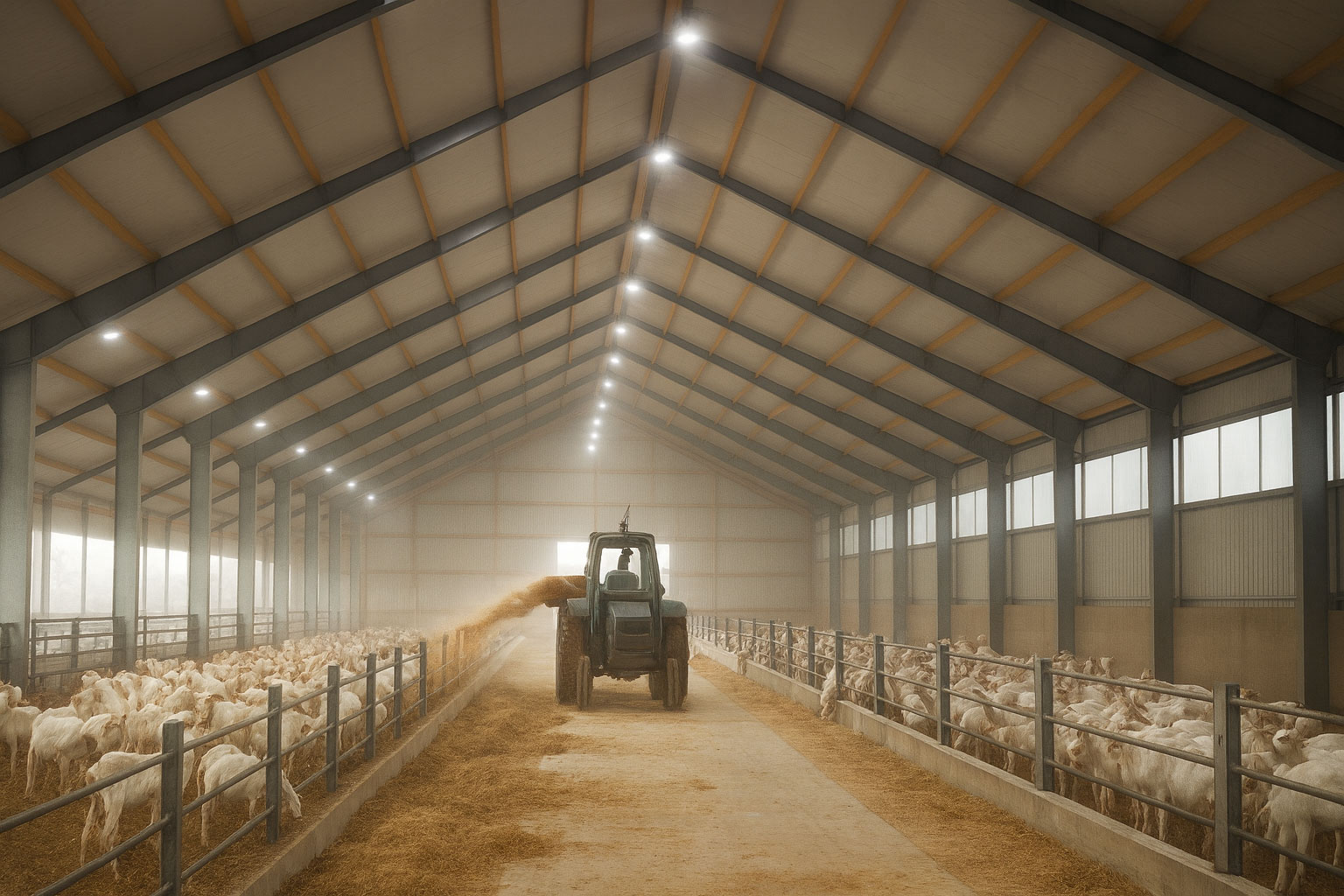
UK compliance, lux levels & smart controls

Welfare-first lighting for poultry & livestock
Smooth dawn/dusk schedules and flicker-free, dimmable LEDs support natural rhythms in poultry houses and livestock sheds. We set welfare-aligned targets (e.g., 20–60 lux in poultry during grow-out, higher levels for inspection), with uniform, low-glare light that reduces stress and improves feeding and activity. Systems use 0–10 V/DALI-2 scenes for cleaning, vet checks and night set-back, plus daylight harvesting where side lights or rooflights are present. Result: calmer stock, better growth and measurable energy savings.
Wash-down & ammonia-resistant luminaires
Farm environments are tough, so we specify IP66, IK08–IK10 fittings with sealed optics, stainless fixings and ammonia/chemical-resistant housings for barns, parlours and poultry sheds. Cables and glands are selected for high-pressure wash-down, and drivers are rated for long run-times and heat. Add self-test emergency in staffed areas to BS 5266, and integrate sensors for occupancy, daylight and scheduling. Every project includes a lux plan, ROI forecast and an as-fitted handover pack for easy compliance.
Benefits
With better control over the light spectrum, farmers can adjust lighting to boost feeding efficiency and reduce stress.Poultry see best in the red and blue parts of the light spectrum. By adjusting the balance of these wavelengths, farmers can influence feeding patterns. For example, using more red and blue light in the evening can encourage poultry to eat more during their naturally active feeding time.
LEDs also help control when and how much poultry eat. By tuning the light spectrum to match specific growth stages, farmers can optimize feeding times and improve intake consistency. This creates a more organized feeding routine and better nutrient use.Finally, LEDs can reduce stress by mimicking natural light patterns. Smooth transitions between light and dark (like sunrise and sunset) help maintain healthy circadian rhythms, which leads to less stress and better overall health for the flock. In short, using LED lighting with precise spectrum control can improve feeding, reduce stress, and boost productivity in poultry farming.
Our LED lights are designed to help farmers fine-tune lighting for the best results, whether for maximizing feed intake, nutrient use, or overall yield.
- Improved Feeding Behavior: By adjusting the red and blue wavelengths, farmers can stimulate increased feed intake, especially during the birds’ naturally active feeding times in the evening.
- Maximized Growth and Productivity: Tailoring the light spectrum to different growth stages helps optimize feeding efficiency, leading to better growth rates and overall productivity.
- Reduced Stress: Smooth transitions in lighting that mimic natural dawn and dusk patterns help maintain the birds’ circadian rhythms, reducing stress and promoting healthier poultry.
- Better Feed Conversion: Precise control over the light spectrum can improve nutrient utilization by encouraging more consistent and orderly feeding habits, which leads to better feed conversion ratios.
- Enhanced Welfare: Customizing lighting to the poultry’s needs improves their environment, supporting overall well-being and reducing behavioral issues like aggression or stress.
- Optimised Feeding Windows: By adjusting lighting to fit feeding schedules, farmers can ensure poultry eat during the most efficient times of day, improving overall intake and nutrient absorption.
- Increased Egg Production (for Layers): Proper spectral tuning can influence hormonal cycles, potentially boosting egg production in laying hens by creating optimal light conditions.
- More Control Over Flock Behavior: Spectral tuning gives farmers greater control over poultry behavior, such as encouraging rest, activity, or feeding, leading to better flock management.
- Energy Efficiency: LED lights with spectral tuning are energy-efficient, helping farmers cut costs while still optimizing lighting for maximum poultry performance.
- Reduced Disruptions: Targeted light adjustments can minimize disruptions to circadian rhythms, reducing potential negative impacts on appetite and overall health.
Why choose LED Poultry & Livestock Lighting
Promoting Focus & Productivity
Energy Efficiency
LED lights with spectral tuning are energy-efficient, helping farmers cut costs while still optimizing lighting for maximum poultry performance.
Enhanced Welfare
Customizing lighting to the poultry’s needs improves their environment, supporting overall well-being and reducing behavioral issues like aggression or stress.
Reduced Stress
Smooth transitions in lighting that mimic natural dawn and dusk patterns help maintain the birds’ circadian rhythms, reducing stress and promoting healthier poultry.
LED Warehouse Lighting; What to Choose & Why
Colour-guided quick picks for aisles, racking, packing and yards, built around safety, compliance and savings.